
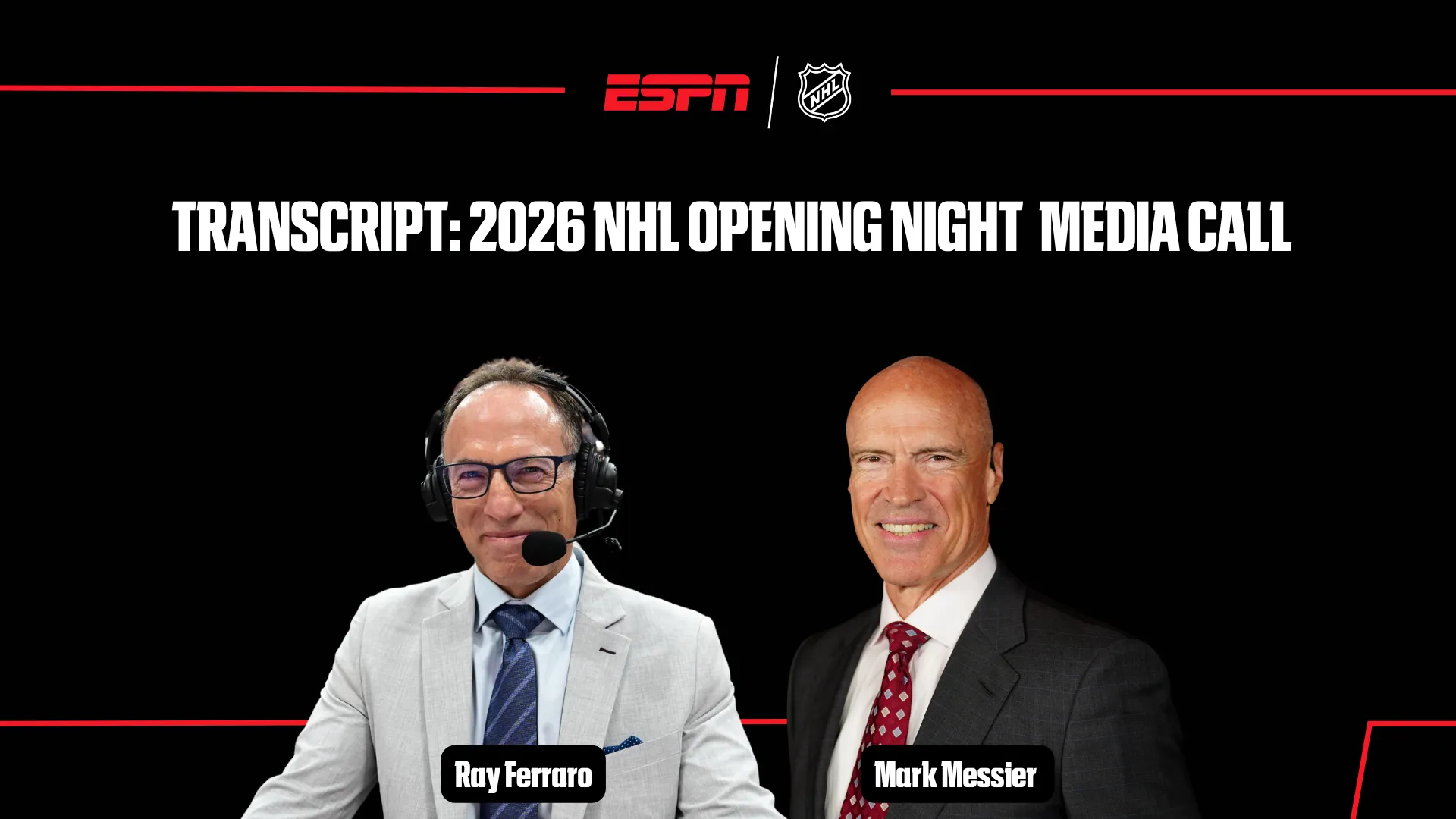
ESPN commentators Ray Ferraro and Mark Messier
Today, ESPN NHL commentators Ray Ferraro and Mark Messier were joined by media for a discussion of NHL opening night and the season, which begins, Tuesday, Sept. 29 at 5 p.m. ET on ESPN.
A TRANSCRIPT OF THE CONVERSATION IS BELOW:
RAY FERRARO: Good afternoon or morning, everybody. Kind of strange to think about the season starting in September. Even if it’s just a couple of days, maybe a week earlier than last year, it feels like everything is rushed.
I’m really interested to see many things, really. Usually, it takes at least seven to ten games to figure out where they are and what they’re going to be. That’s going to be the middle of September this year instead of October — or start of October, not the middle of October. Everything is going to be compacted early, and we’ll get into the rhythm of things.
I open up in Boston, the middle game of the triple-header. The Bruins had a really good year last year, the Rangers not so much. Let’s see what the Rangers, with all the changes they’ve made, what they can be this year.
I think most of us think Florida is going to be really good. Again, they’re healthy, and they added Brady Tkachuk. 84 games is a long, long road, and I’m just interested to see what the new rhythm of the season will be like.
MARK MESSIER: Good morning, good afternoon, everybody. I’m with Ray; this is my sixth year going into ESPN. I think it’s my sixth year. Maybe it’s more; I can’t even remember. Much like a player, every year I just seem to be more and more excited at the start of every season. There’s so much possibility.
As a player when I played, obviously our focus was to try to figure out a way to win the Stanley Cup every year, and I feel the same way as an analyst now. Every year there’s so much to talk about, so many headlines, so much movement, young teams trying to get over a threshold. You’ve got veteran teams trying to hang onto the rope. You’ve got player movement.
It seems like the game and the NHL just gets better and better every year. We’re lucky enough to be a part of it and to bring it to the living rooms of everybody around the country and for some parts across the world, which is insane to think about, that that’s our responsibility.
Yeah, I’m just really excited to see how it’s all going to unfold, and I completely agree with Ray. I think the parity in the league — you’ve got to hit the ground running from day one. I don’t think you can get off or afford to get off to a bad start, 2-8 or 1-9 or 3-7, and try to catch up, especially in some of the divisions that are so closely contested.
I think we’re going to see some really intense, important hockey right from the jump start this year, from the puck drop, which is super exciting.
Q. Ray, with the Hawks seemingly entering a different stage of their rebuild, where do you think they are in their competitive — are they in a competitive window yet? It’s been quite a long time. And for Mark, has any of this rebuild, do you think, helped or hurt Connor Bedard in his development into becoming a league superstar?
RAY FERRARO: You say are they in a competitive window? Well, the first part of competitiveness is to play games that mean something past the middle of March, like you’re in a playoff hunt. I think that would be the first step to saying whether Chicago is in a window yet.
They’re still so young, and I kind of feel — I felt this about Buffalo. While they were in that 14-year no-playoff streak, the players today wear it, but they’ve got nothing to do with what happened 10 years ago where the Sabres started to struggle. It becomes almost an inevitability that they’re going to get better.
I think Chicago is at the start of that, where they’re going to start to get better. Now, they bring over a kid like [Roman] Kantserov, how good is he going to be? I don’t know that anybody can really know until he gets in on a regular basis.
What will Kane be able to produce? He became almost like a power play producer last year in Detroit. Can he help 5-on-5? Are their D growing at a pace that they become a really stable team because they just — they weren’t. They gave up over 270 goals last year.
I’d say they’re at the start of the competitive window, but the first step to me is to play those games past the middle of March.
Q. His [Connor Bedard] role in a franchise that has been rebuilding while he’s been growing. What effect do you think that has on a player like him?
MARK MESSIER: Okay, well, first of all, I don’t throw the term around superstar loosely, so I think we’ll start there. I think Connor is a good player. Maybe he’ll become a superstar. Maybe not. We’ll see.
But if you look back in history at all the superstars, if we want to use the term superstar, all the way back to Guy Lafleur might be the only superstar that came into the league with a powerhouse behind him, in the Montreal Canadiens, and it took him five years to be able to work his way into a lead role because they were so strong.
So then if you fast forward to there to Bobby Orr and then you go maybe Wayne Gretzky in Edmonton, did the Oilers’ five-year process hurt Wayne’s development at becoming a superstar? No. The superstar is supposed to carry the team on his back if you’re a superstar.
Mario Lemieux, did the team in Pittsburgh while it was rebuilding hurt Mario Lemieux’s rise to stardom and superstardom? No, Mario carried the whole franchise on his back. That’s what superstars do. That’s why I don’t throw around the term superstar lightly.
It’s a role of a superstar to take the franchise, put it on his back and carry them to a Stanley Cup. Maybe that’s going to happen in Chicago; I don’t know, but we’ll see.
But it’s not the responsibility or the team’s fight for relevancy and going through these teardowns and buildups or whatever you want to call them. That’s all part of it. Obviously good players, hopefully superstars, are a big part of the rebuilds, and we’ll see if that can happen in Chicago.
Q. Ray, you’ve known Macklin Celebrini for some time. What is a follow-up? What is an encore to all that he accomplished last year? How can he get better? Then maybe the second part to that is he’s kind of started to embrace some opportunities off the ice. He was recently on a Hollywood Reporter magazine cover. Does he have crossover appeal that can cross over into the greater sports sphere?
RAY FERRARO: First of all, Mack is — I think it’s pretty clear, when Mark was talking a little bit ago about a superstar, Macklin has a lot of those qualities that are very evident. I mean, the comparison has been made many times. He’s this generation’s Sidney Crosby. He plays the game the same way; he plays it at the same pace.
If we go back to a younger Sid, the engine that he performs what he’s doing at is always on the red line. He’s smart. He’s competitive. What’s the next stage for him? Is the team continually getting better around him?
It’s funny, he could have a few less points and have a better year. It’s not like he’s going to get 110 points, 120, 130, 140. It just doesn’t work that way. But Mack is already, in my mind, touching the legit superstar, the next phase of the game, that sort of player.
Vancouver had the worst record in the league last year. They lose the lottery, and they get Caleb Malhotra, they didn’t get Gavin McKenna. San Jose was terrible and they get the first pick, and of good fortune, Macklin is sitting there.
It is a remarkable thing to watch a young player, and there’s several of them in the league, that they just come in and they’re not fearful, they’re not scared, they’re not timid, they don’t wait their turn. They’re just ready to play.
As far as the crossover thing, I’ll go back to the younger guys again just for this. This is the way of the newer kid, the newer player coming into the league. They’ve all grown up with a phone in their hand. They’ve grown up with social media. They’re not intimidated by it. They welcome it.
Go back to when Mark was one of the most dominant players in the league, and it was his personality, aside from his brilliant play, that made him a breakout face of the league. The kids now welcome that. They want that. They’re comfortable in it.
I hope Mack continues on that way. There is room and need for it. Some guys it’s just easy, and some guys it’s more difficult. For Macklin, that stuff is easy. It just bubbles out of him. I can’t speak more highly about him than him as a kid, the way that he was raised, his work ethic, talent. Man, what a win for San Jose.
Q. Mark, not a lot of people realize the minor league games you played were in Houston. Does it surprise you a city of that size has never gotten an NHL team through all the rounds of expansion and relocation over the years?
MARK MESSIER: I think they’re ready for it. I think they might have been ready for it in the past. There’s no question they’re ready for it now. I think they’re in the conversation of expansion.
It was a long time ago, obviously since then. I played five games for the Houston Apollos, I think is the Oilers farm team. I got sent down for five games because I missed a flight, I went to the wrong airport.
RAY FERRARO: What city were you in? You weren’t in Edmonton when you missed a flight, were you?
MARK MESSIER: Yeah, I was in Edmonton. I went to the municipal airport instead of the international airport, so when I got there, there was no cell phones or anything at the time, so when I got there, I found a pay phone, phoned the office and I said I’m at the wrong airport.
They said, don’t worry about it. Go to the international airport. Your ticket will be waiting for you to meet up with the team. I got there and went to the Air Canada desk, but instead of going to Detroit to meet the team, the ticket was to Houston (laughter).
So that was my introduction to Houston for five days, and God bless his soul, Ace Bailey was a player/coach down there who tragically lost his life in 9/11. It’s just so sad to even talk about. But he put me under his wing for those two weeks I was down there.
It was a great time in some respects. I was glad to get back up, but Houston, I think, is probably well-suited now for an expansion team.
Q. Mark, I know you were bullish on the Sabres last season. They’ve built a strong locker room, and the players themselves actually had a big dinner in Calgary that really turned their season around once the change of GM was made. Now they have a new season without Alex Tuch, who’s certainly one of their big leaders in the room. They have a lot of younger players, big new contracts. They expect a lot for on the ice. In your mind, what is the process of a young player developing their voice in the room to try to become better leaders and fill some of that void when a guy like a Tuch leaves?
MARK MESSIER: Well, I can only speak for myself and the great leaders that I had as role models and examples of what leadership is, starting, obviously, with my dad through junior hockey and all that, but then getting to the National Hockey League and having guys like Ron Chipperfield, who was an amazing guy, then Lee Fogolin and all the players that kind of got us started in Edmonton.
As a young player, you come in, and even though you might have been a leader growing up in some of your minor hockey league and then obviously into junior or colleges, it’s different getting to the pro level. There’s a lot at stake becoming a leader — lives, families, hard decisions need to be made. You need to be an amazing example. You’ve got to do what you preach.
So, there’s just a lot. I’m always horrified when they make these players captains, leaders too early in their career because it’s just never — it normally doesn’t end up very good. There’s obviously some examples where it has worked out, but overall I think about myself even not becoming a captain until Wayne left, eight or nine years into my pro career, and then maybe I felt comfortable taking over that position.
So, I think for Buffalo, you’re right; it doesn’t really matter — it does matter actually who’s coaching. I think coaching is the most underrated position in all of sports, especially nowadays, and then the GM obviously.
But the players ultimately have to create some peer pressure amongst themselves in the dressing room. They have to hold each other accountable. You can’t be relying on the coach to come in there and hold everybody’s hand and make everybody accountable and scolding everybody or praising everybody.
It has to come internally from the players, and the players themselves have to decide what they want out of it. What are they there for? Ask the question, what are we all here for? You’ve got to get super honest with each other, and if you all can kind of come to some kind of consensus of we really want to try to win a Stanley Cup, how are we going to go about doing it?
And that’s where the coach comes in and the GM comes in so you’re all kind of working towards it together. But ultimately in the end, the players have to govern themselves. If the room and the players can’t do that, it doesn’t matter if you have Toe Blake or Al Arbour and Scotty Bowman all in there together; it’s not going to matter.
The players govern themselves, and good leadership is hard to come by. We know how valuable it is. We’ve seen where leadership is lacking and how much it’s hurt.
Obviously the Sabres, whatever happened in that meeting, if that’s what was a catalyst to kind of get them on track, they obviously decided themselves that they’re sick and tired of being losers, and what are we going to do about it? And things changed around for them.
So young guys becoming leaders, at some point they have to take the team over. Lee Fogolin turned it over to Wayne just before we won the first Stanley Cup, and Lee understood that it was his time, it was Wayne’s time to lead the time. He was ready to do it, and it worked out well. But was that four years, three, four years into his career?
They’ve got to identify who the leaders are, and that will be a big part of the success of any young team, especially for the Sabres coming off of, I guess what they would consider a pretty successful or semi-successful season getting to the Playoffs and putting on a good show. We’ll see how it goes from there.
Q. This is very good timing following what Mark’s remarks just were. I wanted to ask you about the hiring of Mike Babcock in Edmonton, if it surprised you, and what you think of that situation? It could be for both of you.
RAY FERRARO: Sure. I was surprised that Babcock is back. Certainly, the dynamic with Connor McDavid and Leon Draisaitl and Zach Hyman played a role. I’ve never heard — I’m pretty sure Mark would agree — of the players interviewing the coach. Like, I’ve never really heard that. But I guess they wanted to be comfortable with what they were proposing to bring in.
I am interested in — I know there’s a lot of focus on what happened in Columbus, which I don’t even know how you’d describe that. But I’m more interested in it’s not like Mike went to Toronto and had a terrible — well, they were a terrible team when he started, but to be quite clear, they got good with Matthews and Martin and Nylander, et cetera — and they weren’t able to get anywhere.
Now, is that the players? Is that the coach? Is that a combination of both? It feels like this is a tipping point type of year in Edmonton where it’s either they go pretty well, or it just isn’t. I don’t think there’s a lot of middle ground.
I know with Mike, the experience of being around him, and my son was in Detroit’s organization for a while, nobody will have a question about what their role is or what they’re supposed to do. Mike, as you know, likes to talk in 15-second bursts, and everything is extremely direct. It’ll either work or it won’t.
But I was — I guess it’s pretty obvious, but I was quite surprised that he was the way that they went at this time. You don’t have a whole bunch of players jumping out and saying, hey, Mike is a great guy, that played for him in the past. They say he’s organized, he’s detailed, he’s direct. That’s what Edmonton is getting.
MARK MESSIER: My mom always told me if I didn’t have anything good to say, don’t say anything at all (laughing). I am absolutely shocked they hired him. I’m absolutely shocked from the stories that I heard from very good, reputable, character people about the way they were treated. It’s been no secret.
I agree with Ray the way that he was onboarded through the players interviewing him is absolutely something that I’ve never heard of before. Maybe the game has changed, and that’s the way it’s going. Great. I don’t know. It certainly wasn’t like that.
I think there has to be a separation of powers on the structural level of any team. I think from the management to the coaching to the players, there has to be a divide. The leadership of your team have to protect the players inside the dressing room. How can you do that when you’re directly involved with the decisions they’re making at the management level and hiring of the management and coaches? I don’t understand it.
Maybe the game has changed to the point where that’s the way things are going now, where players have that much say. I just don’t know, if it does go bad and players are having difficulties, who do they turn to?
Because if they turn to the leadership, the leadership is management. There’s no separation there.
I am just horrified about the whole thing, to be honest with you. I could go on and on and on, but I think you get my point.
Q. My question is about Carolina, their chances of repeating. In the East it looks like Florida could be one of their biggest obstacles. Ray was talking about how they’re back. Can opening night set a tone for something like that? Do you guys expect that game to be some kind of tone-setting game for what could be happening to those teams this season?
RAY FERRARO: I think there will be a little bit of stand-your-ground type of stuff. You don’t have to look too deep to go those are two of the very best teams in the league, and they’re going to kick the ball opening night, and each wants to show that they’re not going to give an inch to the other.
What does it mean in the long-term, of course, is not very much because it’s going to play itself out over the course of the season.
As far as repeating, I just think it’s impossible to do, except Florida did it two years ago. Mark would know far better than me, but to win, you have to be the best team, but so much has to domino in your factor, in your way. Carolina, it took them eight years to get it done, and by the end of the year, I think it was pretty clear they were the best team.
For me in that final series, they just — there was a break here and a break there, but man, they just wore Vegas out. I am so impressed with what they’ve done there, and really Florida has done the same things. I think there’s some teams that just go collect players. Carolina, they have built and bought players that fit in the Carolina way of playing, and Florida has done the same thing.
When I think of Carolina, and you get guys like Robinson and Carrier, Martinook, those are Carolina players. I don’t know if they would be as successful elsewhere. Maybe they would. But man, you look at them, if you didn’t know what they looked like, you could change their jerseys around and go, man, they play fast and hard and direct.
I think Brind’Amour is as good as anybody. Man, they’re just so good. Now, is Brandon Bussi going to be able to hold up with Kochetkov in goal? I don’t know. He did last year. He had 31 wins. Is Markström going to be able to hold up in goal in Florida? I don’t know. He was statistically one of the worst goalies in the league last year.
But there’s still so many questions that will have to play themselves out over the course of the year, but man, what a great way to start. The banner goes up. The last three Stanley Cup champions are sitting there in Carolina. It’ll be a great start to the season.
Q. In both your opinions, I don’t know if he was being facetious, Rod Brind’Amour, when he said, let’s scrap the preseason and go right to 86 games? Given who he is, I don’t think he’s being facetious. What would be your thoughts on — I see some dangers in that. I also see some advantages. Especially as a fan, if I’m paying full freight for the 43 home games, I can see the virtue in it. From both your perspectives, what will the challenges be and what would the good points be of an 86 games with no preseason?
MARK MESSIER: I didn’t see the quote. Obviously he was being facetious. I don’t really have a comment on it.
RAY FERRARO: I would think the season is long enough. I do think, even though I hated playing them, there is value in the exhibition games to get your feet back underneath you a little bit.
It always seemed like the first game, everybody was just skating around, and the second game somebody would hook you a little bit and bump into you a little bit, and by your third game, you were playing, and then the season started. That’s always how I felt about the preseason.
It does seem like a rock going downhill right now. Oh, gee, they just started. Oh, the season starts. I got a notice on my flight for Monday that I’m flying for Boston. I forgot, they’re not playing four and five exhibition games.
I mean, you are right about Rod, though. I’ll tell this one quick story because I loved it last year. They scored into the empty net. There’s a minute left. The Cup is over. It’s finished. They’re up 3-0. It’s over. The guys are jumping up and down on the bench, and Rod’s walking back and forth behind the bench yelling, one more minute, one more minute.
They could have taken the goalie out and won the Cup. I’m like, man, he never has an off switch. It’s really something.
Q. The Panthers have made several changes this offseason, bringing in Brady Tkachuk and Markström, do you see the Cats getting back to the level they were two years ago?
MARK MESSIER: I’ll start on that one. A lot of talk about Florida. Last year I think everybody realized they just ran out of gas, thinking about getting there — was it three times, winning two? Remarkable. Remarkable consistency, grind, grit, focus, heart, courage — all the superlatives.
You want to talk about a team to be able to do that in this modern salary cap era is just insane: coaching, ownership, management, culture. I mean, everything. Last year you could just see they had worn out, and obviously the injury to Markov was a stamp on that.
Can they get back there? I think they have some amazing pieces. They’ve got a lot of experience. For me, the biggest thing is going to be goaltending. You don’t do what they did without a guy in there that can absolutely shut the door when needed, but Bobrovsky was able to do that for them.
You know, we’ve seen great teams throughout the years, but every one of them there had someone that could play the way he did for them through those years. Do they have that this year? I guess that’s going to remain to be seen, for me anyways.
RAY FERRARO: I would agree, Mess. The stability that Bobrovsky brought — and it wasn’t always that he was stopping the puck at 93 percent and, oh, he erased all these mistakes in front of them, but he brought them stability and predictability in goal when he was at his best.
Now, like a lot of their team, I thought he just kind of lost it last year, just ran out of gas. He played a lot of hockey over the past couple of years, and he’s 37 years, 38 years old.
Markström has not had a predictable, consistent scorecard, certainly over the last couple of years. They’re going to ask him, obviously, or hopefully for them, to stop the puck less. He’s going to face less danger chances than he might have previously, but they at the very least need consistency from him.
I know these guys had nothing to do when Markström got drafted there, but he got drafted 18 years ago in Florida, and isn’t it just kind of wild that all this time later, they go right back to Markström. The road leads them back to a draft pick that they had in 2008. I think that’s the biggest question for them.
Q. Obviously in Canada there’s a lot of angst about the Stanley Cup drought, but that angst recently is more about American superstars, will they stay? My question is why are so many American superstars looking to move south of the border, and do you think that will have any impact on the way rosters are built through the draft, et cetera, going forward?
RAY FERRARO: It is interesting. It’s a thing, right? Quinn Hughes wanted — he’s orchestrated his way and wanted to go somewhere else. He’s in the States. He’s in Minnesota. Brady Tkachuk, the same thing happened. Auston Matthews is still in Toronto.
I think there’s certain players that are going to be able to dictate where they want to go. For the most part, players are not going to be able to.
As far as drafting players, interesting, I guess, is you draft a player, you get him for eight years. So, are you going to make a decision for nine years down the road and bypass a player that perhaps is obviously the choice in that draft selection? Are you going to bypass that because in five years or eight years or nine years he might say, I want to go to the States?
I guess I would say when they do the drafting, the run-up to the draft, they’re interviewing these kids. They’re trying to get a feel for what their mindset might be. I guess that’s going to be part — maybe it becomes more of what they try to uncover as they’re talking to these 18-year-old players.
But I would say it’s far less likely than more likely that all the American players are going to say, I don’t want to play in Canada. You’re so fortunate to be in the league that there’s very few players that can dictate where they’re going to go.
I could have said at one point, hey, I don’t want to be here, and I might have got one of those plane tickets Mark was talking about when he missed the flight in Edmonton. Yeah, I’ve got a flight for you; it’s not any of the cities that are in this league.
MARK MESSIER: Yeah, I agree with Ray. It’s a double-edged sword in my opinion. I think when you draft a player and you’ve got him for eight years, there’s got to be some responsibility on the organization team part to build a team that’s competitive, and if you’re in a situation, you are a good player and you’re in an organization that hasn’t done a good job, hasn’t drafted well, hasn’t put a good team together and you’re sitting there in mediocrity and you’re saying to myself, why would I want to stay here? I think that plays into it.
I agree with Ray; I think it’s such a privilege to play in the National Hockey League, and the players are going to — do seem to have, some players, to Ray’s point, have a little more power of where they play, but overall, I can’t imagine a player going to an organization, having success and then wanting to leave, unless there’s some circumstances around health and family. There’s always some of that.
But overall, if you get drafted by an organization, you have a great run, you win a Stanley Cup, you have success. I don’t know, eight years is a long time. Like I said, I think both have a responsibility — the player has a responsibility to give everything he has. The team has a responsibility to do the right things, make the right moves, build a team, build a contender so they’re competitive.
I’m thinking to myself, if I’m a young guy, even back when I played, after eight years and I want to win a Stanley Cup and the organization is not doing a good job, I would definitely think about wanting to go somewhere else or leave, whether it’s the States or Canada.
I played the game for one reason, and that’s to win a Stanley Cup. If you’re in a situation where you don’t trust or believe that’s going to happen and you put a solid eight years in, I think that’s enough. You should be able to go somewhere.
Q. This is for both Mark and Ray. There have been bigger contracts that have been signed since, but the Leo Carlsson offer sheet was obviously a big summer storyline here. I’m curious as to we’ve seen an immediate effect of it, but what do you think will be the long lasting effect of that offer sheet on the industry? And about Leo himself, do you think now with his huge jump in salary, he’ll be maybe a target or have a bull’s eye on him?
MARK MESSIER: I don’t think so. You know, I think that’s one of those circumstances that wasn’t really player ability. Obviously, he’s a great player, got great potential. He was in the right place at the right time. Philly took a swing, and Anaheim matched, which I think everybody thought they would.
I think it’s just one of those outliers. Would he be worth $19 million on the open market? Would someone pay him that much? Maybe, maybe not, I don’t know. My guess is no, but being in the right place at the right time, he was fortunate to take advantage of what the rules are, if you will.
I also do believe that it’s a way to weaponize that rule as well, that tender offer. You think about teams that are really building a great young corps like Anaheim did, that could obviously — whether it’s $5 million extra or $4 million extra or $3 million, that’s another good player, so it can kind of hurt the roster in some regards.
So as a competitive balance, you could slow teams down doing that. I think we’ve seen that before. We haven’t seen much of it, but that certainly was something that Anaheim had to even consider themselves whether they were going to match or not and what it was going to do to their salary cap and their structure and their players and who they’re going to have to let go and who they’re going to have to lose.
I think that is an interesting weapon to have to not only help your own team — obviously, if Philly would have got him, it really would have boosted their team and they would have had the money to do it, but also to slow down other teams from taking away that much money into one player. I don’t know if Ray agrees with me.
RAY FERRARO: I do, but when you said guys in the right place at the right time, we’ve got this literal No. 1 center that teams are dying to find. Like they’re so hard to find.
I talked to Joel Quenneville last year at the start of the year, gee, how good is Carlsson? I haven’t seen him yet. And he couldn’t have been more excited about what the potential of how good Leo already was and what he was going to be.
So that’s number one. He’s a unique player. He’s a literal No. 1 center. Number two, the cap goes shooting way up, so all of a sudden Philly has got all kinds of cap space. They wouldn’t have had that kind of cap space in a normal offseason because the cap will not jump as quickly as it did last year over the next few years. They were in a good spot to make the offer sheet.
Next part of this is I know some people say, oh, well, I’d let him go and I’d take the first-round pick or the following first-round pick. If you’re a general manager, how long are you going to be the general manager if all you have is a bunch of draft picks in the future and you’re looking for a No. 1 center again and again and again?
Because the team that signed him, they’re not on the bottom of the league. Philly is looking — Philly made a jump last year. If there’s one hopeful in their team that you can easily identify, it’s that they don’t have a legit No. 1 offensive center man. So Danny Briere and Keith Jones went out and went, that’s the guy. I think there’s a lot of factors that come into play.
Also, I would say — you mentioned would he be a target. If I am any other player in the league, if I’m Connor Bedard who signed for $15 million, I give him a shin pad cap and say thank you because my bucks have just gone to another level.
What does it do? The top salary will draw other salaries towards it. If Leo Carlsson is worth $18 million, what is Cutter Gauthier worth? What is Beckett Sennecke worth? What was Connor Bedard worth? All these young guys are taking a leap forward. If it’s anything of a target, it’s a Christmas card that he’s going to get.
I’d love to be in that realm of, oh, that’s dragging my salary along too.
MARK MESSIER: I think it does drag a salary along, though, Ray. I just don’t think they can use that as an example of what their worth is because I think they would agree that Carlsson wouldn’t get that money if he wasn’t getting that tender sheet. But right, I think obviously all the salaries are going up, so if Cutter Gauthier looks at that and he’s worth 19, then I’ve got to be — what did he sign for 15 or something like that? Which is unbelievable, right?
I think he was probably happy with the 15 —
RAY FERRARO: I’d guess.
MARK MESSIER: Obviously thrilled with the 15.
RAY FERRARO: Oh, man. That is something, though, in a bigger picture, the way that the teams have now pivoted their commitments and expenditures to their younger, in a lot of cases unproven, players, that’s the way they’re trying to combat what might be an offer sheet or what might be the expanded cap space that a player would look at and say, oh, I can go to that.
Ryan Leonard got 20 goals last year; he’s $10 million. Justin Sourdif signed a long deal. The deal in Pittsburgh for Ville Koivunen, and he’s got two goals in his career. He signed eight years, $32 million.
For us guys, it’s unfathomable. Who cares; that’s just the way it goes now. I wish I was born in 2004, not 1964, because 40 goals might have paid a little different, that’s for sure.
-30-
CONTACTS:
ESPN
Andrea DiCristoforo | andrea.dicristoforo@espn.com | 213-405-4612
Megan Nelson | Megan.S.Nelson@espn.com | 310-741-0689