
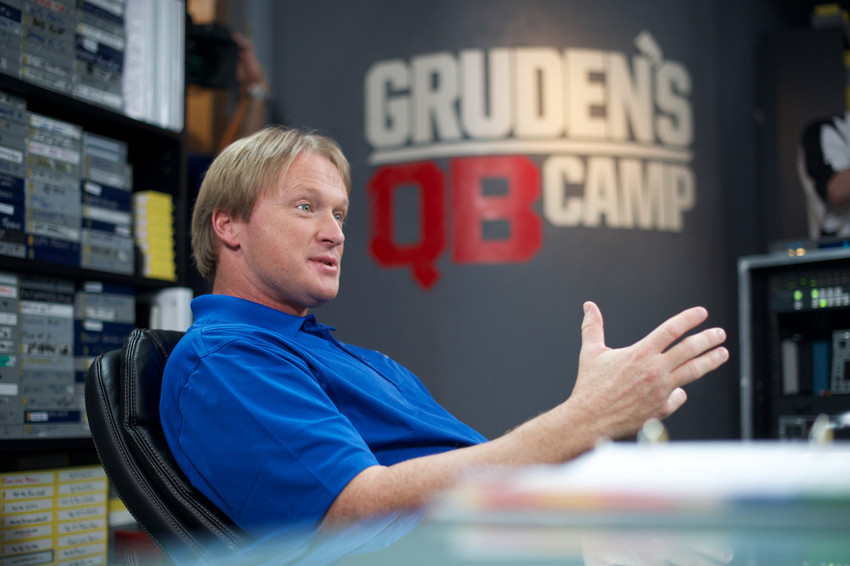
ESPN conducted a media conference call today with Monday Night Football’s Jon Gruden to discuss the SportsCenter Special: Gruden’s QB Camp series and ESPN’s 2013 NFL Draft coverage. ESPN will provide live gavel-to-gavel coverage of the NFL Draft from Radio City Music Hall in New York, April 25-27, and Gruden will provide analysis on the main set the opening night in primetime. Full audio replay; Gruden’s QB Camp TV schedule and photos). Transcript:
Q. Jon, can you talk about maybe your two or three favorite quarterbacks in the draft this year? When all is said and done, what kind of players you think they’ll be when their career is over?
JON GRUDEN: Well, that’s a great question. I think it depends on what kind of system you run. I think, obviously, with the game changing the way it is, the option coming into the NFL, we saw what (Colin) Kaepernick did, Russell Wilson, [Robert Griffin III] RG3, you see that going around the league. Chip Kelly coming to the Philadelphia Eagles. If you’re in the NFC, the read option, the option itself is a prevalent part of the game. So guys like E.J. Manuel, Ryan Nassib at Syracuse, I think those are the two players in this draft that are equipped to run that style of offense.
I like Nassib a lot as a sleeper in this draft because he can run the option. He did it at Syracuse. He managed the no‑huddle offense. He has size, athleticism, and he has an NFL pedigree of having played for Doug Marrone. And I like E.J. Manuel, obviously, because of his size and running ability.
But outside of that, there are some very good pocket passers, if that’s your cup of tea. Guys like Matt Barkley, Landry Jones have hung in the pocket and made a lot of completions during their career. Geno Smith, those three guys in particular throw the ball very well.
But I would say it depends on the kind of offense that you run and what you’re looking for. There is a lot of, I think, interesting prospects that can help a team in this draft.
Q. Last year when Russell Wilson was drafted by the Seahawks, your comments were pretty dead on. You said at the time, if they give this guy a chance, he’ll win the starting job. I wonder what a lot of people miss in Russell Wilson, if they missed it at all last year, and the fact that he fell to the third round and it reshaped the thinking of some of these guys maybe like Gus Bradley who is all about close when it comes to it, the talent that’s out there?
GRUDEN: I think last year Russell Wilson had the “it” factor unlike any quarterback I’ve met. His intangibles weren’t excellent, they were off the chart excellent. He did it at two colleges within a year. I’ve never seen a man do what he did in NCAA football: Take the Wolfpack to a bowl game, transfer schools, become a team captain at another school and take his team to the Rose Bowl. Had it not been for three last‑second plays, they might have won the national title. 71% completion percentage, mobility.
I just thought he had it all. The thing he lacked was size. The only thing he needed was an opportunity. But I’m a guy, I guess, that’s made a living with middle round draft choices. So I was a little bit partial to Russell Wilson. I’m very happy for him and his success.
Q. Is there a Russell Wilson out there or anybody that compares in this year’s class?
GRUDEN: I don’t know if there’s another Russell Wilson. I think what he did as a rookie is unprecedented, really, for a third‑round draft choice. But as I said earlier, I really like this kid out of Syracuse. I like Ryan Nassib because he’s an athletic kid. He’s functioned in a couple of different offenses. What they did this year at Syracuse changing their offense two weeks before the regular season says a lot about this kid’s ability to adapt, a former 400‑pound bench presser. They were 2‑4 trailing Stony Brook College at halftime, and I thought he was really good at the end of games and helped Syracuse go to a bowl game. I just like his body of work at Syracuse.
Q. Talk about Johnathan Franklin at UCLA in comparison to Maurice Jones‑Drew or small backs?
GRUDEN: Well, you’ve got to give him a lot of credit for what he did under the (Jim) Mora regime. He had a fumbling problem his first two seasons. He had a real problem hanging on to the football, wasn’t utilized very much as a receiver. But this year at UCLA he took care of the ball. He was punishing at times between the tackles. He proved he could catch it and protect it and really helped himself. Much like Datone Jones, the offensive lineman who really flourished with the coaching change, and sometimes that happens. But I hate to compare anybody to MJD. I really do. I think he’s a good, solid back. He’s got every‑down potential, but he’s a different type of runner than Maurice.
Q. One of the things people have questioned about Ryan Nassib is if his laid‑back demeanor transfers into an NFL locker room. Do you think he can command an NFL huddle?
GRUDEN: Yeah, I think so. I don’t think a lot of these quarterbacks are type‑A personalities. I like a calm, cool customer, a man that can handle a lot of situations, a lot on his plate from a football standpoint. They give him a lot of freedom at Syracuse ‑ reading progressions, changing plays. I think most players that I’ve been around like playing for a quarterback that knows what he’s doing and is in control of the game. That is one thing that impressed me the most about Ryan Nassib. He’s already got his degree. He’s all business, all the time, I think he’s going to know what to do when the game starts.
Q. When you were breaking down film of Nassib, what was one thing you saw the more you watched film that surprised you or you weren’t expecting that was a positive trait he showed?
GRUDEN: He threw some tight‑window completions, and that’s hard to find sometimes in college football. You don’t see a lot of really contested, tight‑window throws under duress. I thought Nassib proved that he could make the difficult plays when there wasn’t a clean pocket. He didn’t have a great supporting cast, no disrespect to Syracuse. But there were times that Nassib had to make something happen for Syracuse to win, and I thought he did that enough to prove that he can do it at the next level.
Q. You’ve been on ESPN’s draft set now for a couple of years. How would you view your role in the production?
GRUDEN: Well, hopefully people believe that I’ve studied as much tape as the normal guy. I take a lot of pride in having seen the players play a number of games. Obviously with Mel Kiper, Chris Berman, the way the first round and second round goes now from the speed of the draft. Try to be a good teammate, be a good listener, and take advantage of the 10 or 15 or 20 seconds or whatever time you have to give your input regarding the pick or the team that’s on the clock’s pick. So just try to be as prepared as possible and be a team player like I think most analysts do.
Q. Aside from his art ability, what did you learn from Geno Smith from that time of the year with him and things that translate into being a good teammate, locker room presence, that kind of stuff? What he’s going to be able to do, not so much just the statistics, but what he can put up with his arm and all that?
GRUDEN: Hopefully the thing that came across is West Virginia runs a lot of plays in every game. 85, 95, 105 plays, up‑tempo, no‑huddle, lot of pressure on the quarterback to get every play communicated at warp speed. And he has a number of options even on basic running plays. That’s what we tried to show fans on 96 Wanda. Yes, he can hand it. He can also tap it to [Tavon] Austin coming underneath. He has a bubble screen on one side, a quick screen on the other. He has three or four options on every single play. I just think he’s exhausted at the end of every Saturday afternoon.
They put a lot on the quarterback’s plate, and I think it’s very underestimated what this kid can do from a football standpoint. He does a lot above the neck as well as making plays with his arm and his mobility.
Q. I think that is one of the things that a lot of people, and you had questioned it yourself, how he translates to the NFL. What kind of style he fits in and stuff like that. Do you see the versatility that he can be put into a lot of different offenses? Where do you see him fitting in when he does get to the pro level?
GRUDEN: I like that about him the most. I think he’s as complete from a versatility standpoint as anyone in this draft. He can run 4.55. I’ve seen him drive the ball accurately down the field. I’ve seen him throw the ball with touch and accuracy, make quick decisions, and I’ve seen him be dominant at times. Obviously, down the stretch I think they got manhandled in a couple of football games. They didn’t play well on defense. They got into a situation where they had to score basically every time they had the ball, and that is a hard way to play quarterback. People have to remember also that West Virginia switched conferences. That is a real challenge on a quarterback when you show up your senior year and you’re playing a lot of opponents you’ve never seen before in stadiums where you’ve never been. So I credit Geno Smith with not only being productive, but I think his skillset is very versatile, and I think he’s going to adapt nicely to any system that you want to run.
Q. Staying with Geno, I wanted to ask you about two of the more significant criticisms of him: One, being his pocket awareness. He’s got like 32 career fumbles at West Virginia; and the second being his deep‑ball accuracy. Can you touch on both of those?
GRUDEN: I don’t know. Who are the critics? I haven’t heard all of the critics. I know he’s got a number of them as most of these quarterbacks do, but ball security is an issue. There is no question about that. But they don’t use a tight end. They don’t use a lot of maximum protection. They really don’t. This is to a large degree a high‑risk offense. They go up and snap after snap, it’s a pass‑first offense, really, and the quarterback is vulnerable back there. But I’m not making excuses for him. I think he’s got to do a better job taking care of the football, managing the game on a snap‑by‑snap basis. That is something we talked a long time about. It’s not about the yards and the number of snaps. It’s about the execution of every individual play. I think sometimes that gets away from you in this up‑tempo style of college football.
But ball security is an issue. I had him on the field and I was impressed with his deep ball. I wouldn’t buy into that criticism personally. I think he’s an excellent deep‑ball passer.
Q. Based on your dealings with Manti Te’o, who is he on and off the field to you?
GRUDEN: Well, I like the fact that he’s a four‑year starter, and he has tremendous production. I’ve seen him intercept passes, I’ve seen him make all kinds of different tackles, pursuit, second‑effort tackles. I’ve seen him get out of the trash, get off blocks, stuff people in the hole. He can play in a 3‑4 scheme. He can play in a 4‑3 scheme. He never comes off the field. I really like that about him. I’ve also seen him be the quarterback of a pretty doggone good defense. They only gave up 10 points a game. Against Stanford, for instance, I saw him automatic to a blitz. I saw him check out of the blitz.
I think he’s got a real good football aptitude. He plays faster, I think, than people give him credit. I think he’s a very good, instinctive, high‑effort, well‑coached, inside linebacker that’s got to prove he can play on every down. There is no question about that. But I’m really confident that he can do it.
Q. Did meeting him in person change your perception of him with the off‑field stuff? If so, how?
GRUDEN: No, it really didn’t. I know a lot of people in South Bend. That’s kind of where I grew up. I just know the type of everyday leader he has been. His impact on the campus with the student body and with everybody that’s come in contact with him has been tremendous. I thought Derrick Brooks came in and spent an hour or two with him and made some very good points to him about what he’s going to go up against when he goes into a new locker room. Being self‑deprecating and when learning to laugh a little bit at yourself. I think he’s turned the page and he’s trying to move on, and hopefully people give him that opportunity.
Q. The Raiders with [GM] Reggie McKenzie it seems and their free agents that they’ve signed, those guys are almost cut out of a mold. Everybody they’ve signed that you’ve talked to … they’re low‑drama, worker bees and into the sport. It’s kind of a shift from a couple of years ago I think when the Raiders were thought of a projection team. Just curious how McKenzie will do in identifying those kind of guys? Can he turn this around with that philosophy? Are there guys that were on your list that you had in those shows that you think would fit in there?
GRUDEN: I think Reggie’s going to do fine. He’s got an unbelievable pedigree. He’s been around the best football people in the business, guys like Ron Wolf and others. No question about that. He has a background with the Raiders being a former player with Oakland. And I know football character and character is highly touted when it comes to finding and developing players, and Reggie McKenzie is going to find guys that I think fit that criteria. I think all of the kids that we have in here this year have high football character.
I also feel like every once in a while you need some characters. You need a couple guys that are a little off the beaten path, maybe guys that live in the left lane to a degree. But the Raiders are rebuilding. Obviously, they’ve made dramatic changes on their roster. They’ve let go of some veterans that are well‑recognized and I’m sure leaders on that football team. So not only do you have to find character, you better find some playmakers, because everybody else in the league has them.
Q. Tyler Wilson from Arkansas, what do you like about him watching him on tape and talking to him in person?
GRUDEN: I like Tyler Wilson because he’s tough, number one. I saw him as an All SEC quarterback two years ago playing for [Bobby] Petrino. And Petrino, I think is one of the more respected X and O football quarterback men in the business. I saw Tyler play extremely well taking Arkansas to a Cotton Bowl. I think losing Coach Petrino the way they lost him, losing his offensive coordinator, losing three very good receivers and having the injury early in the season against [Louisiana] Monroe derailed Tyler Wilson. I credit him for trying to hold the Razorbacks together and a lot of adversity. This was not his best campaign, no question about it. But he’s tough. He has some functional mobility in the pocket. He’s sharp, and I think he’s got some real leadership traits that are going to work for him at the next level. He’s going to help somebody. He needs to get with the right coach and the right system, no question.
Q. You mentioned the Jaguars need a quarterback. You had Gus Bradley in Tampa. His first NFL job was with you. Did you see some things that he could be a head coach at that point, even though it was four or five years ago?
GRUDEN: Yeah, I think a lot of those guys, Raheem Morris became a head coach. [Mike] Tomlin became one, and Gus Bradley, much like those other two, has a lot of football intelligence. He’s got great charisma. Players like him. He’s enthusiastic every day, creative, work ethic, fun to be around. He’ll be a reason Jacksonville turns it around. It might not happen this year, but he’ll get them on the right track and keep them on the right path.
Q. You know Andy Reid really well. Just wondered which left tackle you see fitting Andy’s scheme and philosophy better, Eric Fisher or Luke Joeckel?
GRUDEN: Last year people picking at the top of the draft were looking for quarterbacks. And fortunately, they were there. If you’re looking for a left tackle this year, you’re a lucky guy because I think there are three of them, to be honest with you. I really like this Lane Johnson. No one talks about him – incredible story of versatility and athleticism. He’s only played one year on the left side. But 6’6″, 300‑plus pounds. He can run and do all the things you’re looking for athletically. But Joeckel to me is the guy I would take. I don’t know what Andy’s going to do, certainly. But you’re talking about a left tackle that not only won the Outland Award trophy as a true junior. He played for two different head coaches, two different systems. Helped [Ryan] Tannehill become a first rounder, helped Johnny Manziel win the Heisman, did it against the best America has to offer in terms of competition. Reliable, athletic, consistent, Joeckel would be the guy I would take.
Then if you took Fisher from Central Michigan, I wouldn’t second guess him, because this is an athletic, big left tackle that is very versatile. He’s played right tackle, he’s played guard, he did a heck of a job at The Senior Bowl. The arrow is pointing up. Those three left tackles are outstanding. I think Joeckel to me is number one because of where he comes from and what his body of work looks like at the highest of levels. But Fisher is certainly a close second, if you ask me.
Q. What are your impressions of E.J. Manuel, and where he would be an ideal scheme fit?
GRUDEN: I like E.J. a lot because I think you can call just about any scheme you want to call. I’ve seen him run the direct quarterback runs. He’s a presence inside the 10‑yard line, much like Cam Newton in Carolina is. I’ve seen him run various option plays, and we know that’s certainly a major point of emphasis in the NFL right now. I know he can bring a lot to the table from an athletic standpoint. He’s a really fun kid to be around. The players like him. He helped the Seminoles win 12 games and an Orange Bowl. I think he can improve as a passer. I think he can improve his protection awareness and understanding. I don’t think he’s anywhere near to a finished product, but I do think he has a big upside. He has a tremendous skillset that allows him to do a lot of different things. If you’re with a creative offensive coach, look out. He could be a good player.
Q. I wondered what your impressions were of Tyler Bray, about his physical skills and his mental approach?
GRUDEN: I had a chance to speak at Coach Dooley’s spring clinic last spring. And had a chance with Coach Chaney to spend a little time watching tape with Tyler. So I’ve known him a little bit behind the scenes better than some of the others. I just think this kid has a rare ability to throw the football, and a lot of what he did at Tennessee, I think, is overshadowed with their win‑loss record. They scored 35 points in Columbia. They scored 44 points in Athens. They scored 48 points against Missouri in losses. So moving the football was not a problem at Tennessee. I just think there is a lot of refinement that needs to take place. He’s got to learn how to manage some situations better. He’s got to deliver at crunch time. He’s got to polish his game. He’s got to do better in terms of handling pressure. He’s not a mobile quarterback. He’s got to know where his hot receivers are. He’s got to know what audible to get to. I think his preparation needs to increase so he can be all that he can be. But when it comes to pure talent throwing the football, there is one thing Tyler Bray can do as anyone in this draft. That’s what he can do now. He can really throw it.
Q. I just wanted to ask you about Landry Jones and what you’ve seen him do over the last year. It seems like his draft stock has gone down since his junior year, and I was wondering what you’ve seen in that process?
GRUDEN: He had a great sophomore year. I don’t remember many sophomore quarterbacks in college football doing what he did. He was unbelievable. But you have him in at 6’4″, he’s thrown for 16,000 yards; he’s won a lot of games. But he did not have his best year. The Kansas State game disappointing. Certainly the bowl game against Texas A&M, you’re disappointed. You expect so much more. But production, his personal traits, we all know he wants to be a minister or a preacher. He’s married and solid off the field. Those are things that I like.
I think when he’s in rhythm and has protection, he’s very, very good. I think when he gets knocked off the spot or he’s under duress, I think he took a step back this year. But remember Oklahoma didn’t have a tight end much this year. In the past they had a tight end, a strong running game, and a better play‑action passing system. Obviously, with the injuries they had at the tight end position, they were more wide open, and that puts a lot of pressure on your quarterback.
They didn’t run the ball particularly well or often, and they were a tad bit one dimensional. But I like Landry Jones. I think if you’re looking for a quarterback that’s proven he can take care of the football, make a variety of throws and be reliable person on and off the field, I think Landry Jones might be for you.
Q. What do you expect from a guy like Andrew Luck after what he did as a rookie, making the transition from rookie year to second year, which we historically know is usually the largest season for growth.
GRUDEN: Well, second‑year players, I think that’s one thing I used to say all the time is second‑year players show the most improvement normally. They’ve been through the rookie year. They’ve seen things now. They’ve been through the routine preseason, he’s even been through the postseason routine. I expect a lot more of the same from Andrew Luck.
He’s one of the rare prospects I’ve ever had the pleasure of seeing come into the NFL. He gets his former offense back ‑‑ offensive coordinator, I should say. So there’s going to be some system familiarity. I think their team will improve with free agency in the draft. They’ve got to prove a lot. Their schedule will be more difficult now. They’ll be playing a tougher schedule, I think. But I really believe Andrew Luck can flourish in any situation at any time. So I’m eager to see him continue to do what he’s done.
Q. A general manager last week mentioned how under the old CBA there was like a loser’s curse with having a Top 10 pick. Can you talk about what exactly he meant and how hard it was under the old system to have a Top 10 pick and to trade a pick like that? Then conversely, last year under the new CBA, there were a ton of trades in the first round. Six of the first seven picks were all traded. Would you expect a lot of trades again this year in the top part of the first round?
GRUDEN: Well, yeah. The guaranteed money before the CBA was significant, and now it’s not as significant, but you still don’t want to miss on a Top 10 pick. Look, the teams that have the worst record pick at the top of the draft. They try to keep the league competitive by doing that. There is a lot of pressure to hit on your draft picks, certainly. But when you’re picking in the Top 10, whether there is a new CBA or not, it’s a critical pick for you. I always felt we’re picking up here in the Top 10 because probably our quarterback didn’t play very well. A lot of teams that you’re going to see picking in the first seven, eight, nine slots had struggles at the quarterback position. I don’t know what else to say about it, but it’s a critical pick. And I do expect trades, maybe not at the top of the round. This is a year where our players in the top six or seven that people covet to go that high and get. I do think though that you’re going to see a lot of trades at the end of the first round, pick number 20 on down, where teams are going to try to get back up in there and maybe take one of these quarterbacks. Maybe try to make a move to get a player that they don’t think they can get later in the second round.
Q. In your opinion, what is the element of playing NFL quarterback to evaluate, the most difficult trait, if you will to project to the pros and why?
GRUDEN: That’s a good question. The speed of the game, number one, you never know how a player’s going to adapt to the speed of the game. The windows we talked about earlier are so much tighter – third down, red zone passing, very difficult. How much they can handle right away. Some of these quarterbacks struggle with adapting to a new system from a snap count, to the terminology, to the audible system. Some guys struggle significantly when they don’t get the reps that they’re accustomed to getting in college. I think those are the big things that are the hardest things for the young quarterback.
Q. I just want to ask you about the lead‑up to the draft and this process, QB Camp has taken off in the last few years and become very popular among the fans, and obviously the draft is huge, and the interest has grown rapidly year by year with ESPN and NFL Network obviously increasing every year…. Did you ever expect it to grow as much as it has over the last 10, 20 years and beyond that that you’ve been involved in football?
GRUDEN: I never really thought that it would get this big. The draft, the NFL Draft, that is, has become a huge spectacle. They used to have a number of rounds on the same day. Now they have one round on one day. They commit one full night to just the first round. There is so much more information available now for fans on the internet. Certainly with ESPN and all of the other networks that cover it, it’s just a huge sport in terms of popularity.
I think the commissioner and the NFL have done an excellent job keeping the game strong and interesting to fans. This is a big vehicle for teams to get better, obviously, the draft. With the popularity of the game, people want to know who the players are that can help their team turn the corner. I think that’s what’s made it so exciting and fun. I’ve enjoyed being a part of it.
Q. If you had your pick of the lot, which quarterback would you take? And if you’re the Browns at number six and you’re looking at quarterbacks, which one would be the best fit?
GRUDEN: They’ve had a lot of quarterbacks go through Cleveland since they’ve been back. I know it would be great if they could solidify themselves. It would be really outstanding. I really like Brandon Weeden, I’ll be honest with you. I liked him last year when he was here. I think he fits Norv Turner’s scheme tremendously, great down the field passer. Hopefully they can get some wideouts that can go down the field and get it for them. I like Weeden, I really do.
Q. If you had your pick of the lot and you were taking a quarterback, which one would you take?
GRUDEN: I selfishly really like this kid in Syracuse. I’ve said that a couple of times. I think he’s a nuisance runner. I think he can scramble for first downs. If we want to run the read option, I think he can execute those plays. He’s really sharp mentally. This is a guy that’s been trained by Doug Marrone, formerly of the New Orleans Saints. So he’s been in a really ambitious offensive scheme, taking care of the ball. He’s proven he’s tough, durable. I like his upside.
Q. You were talking about the windows, and when you look at a quarterback like Matt Barkley who has a lot of things that are required in the NFL. Maybe he doesn’t have the arm strength, but do you think there is more required for a quarterback to throw his velocity into those tighter windows now than maybe 10 years ago when the west coast offense may have been more prevalent? And how do you project Barkley in the NFL overall?
GRUDEN: I think Barkley’s going to be a starter in the league at some point. Obviously, he’s coming off an injury. He’s done an excellent job rehabbing that. I saw him make all the throws personally with my own two eyes. Other than that, he’s going to have to function as a pocket passer. I don’t think he’s going to be a scrambling, option‑style quarterback, obviously. I think he’s going to be a guy that relies on his system, complete execution around him. I think his supporting cast is going to be important to him. But I’ve seen Matt Barkley throw the ball extremely well and in tight windows, and he’s done it for four years. What I love about Barkley is his experience, not only at USC, but he’s also started for four years in high school at a pretty doggone good high school program at Mater Dei. So, you’re getting a kid that can function in the pocket with great anticipation and accuracy. I think he has enough arm strength to be a very, very good at throwing the ball down the field.
Q. How would you describe the process of signing undrafted free agents once the draft is over? How important is that process to building a team’s roster and maybe finding a fit, need based as you move forward?
GRUDEN: I think that process is now more important than ever. Seven rounds, I can remember when my dad was a personnel director in Tampa, there were a lot more rounds in the draft. But we have seven rounds and sometimes you don’t have all seven picks. You need to accumulate players after the draft. So I think it is critical that you have a process in place that allows you to come compete for the players that weren’t drafted. Because there are a lot of good players left on the board that have draftable grades. I think for the most part every organization utilizes their scouts and coaches, and not only find the players that are available on their draft board that fit their needs and fit their criteria, but they also recruit them. You’ve got to get on the phone immediately and recruit the player, recruit the agent, sell the opportunity that he’ll have to make your team and contribute, whether it be as a back‑up linebacker or special teams performer. So pinpointing, earmarking the players left on the board is one thing, and going about having an urgent manner to recruit the player and the agent is critical. Some coaches are great closers. Some scouts and GMs are outstanding closing deals because these players and agents are fielding numerous calls at the same time. It’s almost like let’s make a deal, if you know what I mean.
Q. Two‑part question on the Chargers. Philip Rivers is 31 years old and I think someone who the Chargers believe in for good reason, but they may want to groom someone for down the road. Is there someone not in the top of the draft that looks good? Part two of the question is Mike McCoy, Ken Whisenhunt, what can we expect from them in building this offense?
GRUDEN: Obviously Coach Whisenhunt has had a lot of success with the Pittsburgh Steelers, and he helped Arizona go to the Super Bowl with Kurt Warner and the numbers that they accumulated were outstanding. Coach McCoy got to the playoffs with Tim Tebow and adjusted his offense a year later for the great [Peyton] Manning. So you’re going to have two coaches that have adaptability and a brain trust in place, so I think they’re going to really help any quarterback flourish. I think Rivers is still one of the top players in the game. They’ve got to get him some help certainly on the offensive line, and they’ve lost a lot of skilled players in the back field and at wide receiver. They need to replenish their offense around him.
But as far as a back‑up to Philip Rivers, I think there are a few guys that fit in that mold. I like Tyler Wilson at Arkansas, he’s a pocket passer. I think Tyler Bray as a middle‑round quarterback could come in there and take advantage of watching Philip Rivers prepare on a weekly basis. I think there are a couple guys in this draft, quite honestly, that could come in there and be a good quality back‑up of Philip Rivers.
Q. I’m just curious with you, how much does the system that your offense has, how much would that be a factor for you to just take whoever you think is the best quarterback, period?
GRUDEN: If you need a quarterback and you need one of these players that are going to come in and start, you’re going to take the man that you think has the most versatile skillset. You’re going to need to be able to adapt your offense to that quarterback. That’s why I like Nassib. I think, as I said a little bit earlier, I think he can run just about any play that you can think of, whether it be an option, a full field progression. You want to move the pocket, throw the quick game under center or in the shotgun or you want to go no‑huddle, you want to come up with 10 or 12 new plays this week, I think he can handle it. I think he’s proven he can handle it. So to answer your question, that’s why I like Nassib as much as I do. I do think there are some other quarterbacks that will develop, but I don’t think they’re as ready as Ryan Nassib is because of his pedigree he has at Syracuse.
Q. I’m a little curious about cornerbacks and the different types of cornerbacks in terms of manned cornerbacks, press cornerbacks, and zone cornerbacks. Can you explain the difference and tell me how do you identify that when you’re going through the draft process?
GRUDEN: You look for cornerbacks that have played man‑to‑man coverage, men that have long arms, bump and run coverage skills that you’re looking for, like Xavier Rhodes, for instance, at Florida State. He’s got the size that you’re looking for, 6’1.5″, 210 pounds, he can run. You have to have a certain degree of physical traits to play bump‑and‑run corner. Forget the size for a minute; you have to be able to have those long arms, and certainly you have to be able to turn the wheel and contort your body and react to quickness.
But some corners have a knack for it. It certainly helps when you study the tape and see him doing it. I think Dee Milliner at Alabama because of his background with Nick Saban. You see the high hands and the corner that can play man‑to‑man and find the ball in the blind spot. Those two bump‑and‑run corners in this draft appeal to me more than most of them. The zone corner, you see it in their schemes. Can they reroute the wide receiver, keep vision on the ball, can they tackle? Are they good in primary force? Do they understand where their help is? So when you watch college football in the corner are they a bump‑and‑run, man‑to‑man corner or a zone corner? It’s pretty easy to see when watching the tape.
Q. There is a lot of talk that Alabama might get four first round draft picks again this year. Just first of all how impressive is that to you? Second, you just touched on Dee Milliner, but is there someone that jumps out among these four among Fluker, Warmack, Milliner, and maybe even Eddie Lacy?
GRUDEN: Who really jumps at me is the offensive line period. Jones, the center, the left guard, Warmack is a heck of a player. Fluker at right tackle. I’m starting to think that Mel Kiper could have run for 750 yards at Alabama. That’s what’s most impressive to me is the style that Alabama plays offense with. It’s physical. It’s why they’re the National Champion. It allows them to control the clock. But I like their power running game, particularly when they run right with Fluker at the point of attack and Warmack pulling around the horn it’s downright nasty. And Lacy, Trent Richardson, No. 4, I think his name is Yelden, the young back. I’m not so sure if Mel Kiper couldn’t run for 750 yards, no disrespect to these great running backs they have there, but it’s a very physical offensive line that certainly gives the Crimson Tide a strong edge in college football.
Defensively, they’re just very versatile. You see them play the 3‑4 defense. You see them play the 4‑3. They have a diverse sub-package. They play a lot of different coverages, man and zone, fundamentals and techniques. These players, I think, are ahead of most colleges because of their coaching. And they recruit first and second round draft choices. They do a heck of a job evaluating who to recruit and who to sign. It’s a credit to Nick Saban and his coaching staff.
Q. I was wondering what your thoughts were on Tavon Austin?
GRUDEN: Tavon Austin, I’m glad you brought him up. He’s my favorite player in the draft. I’m sensitive to him because he’s 5’8″ like myself. When you watch the kid play, he’s magnificent. He’s a great return man, punts, kicks. He lines up at tailback, and he plays like a tailback. He looks like Darren Sproles at tailback and he looks like Wes Welker in the slot.
I’ve seen him be magnificent after the catch, all-purpose yardage, look, he’s tough. Tremendous stop and start quickness and flat‑out finishing speed. I’ve seen quick guys, fast players, but I’ve never seen very many that have the combination of speed and quickness like Austin has. He ran for 8,000 yards as a high school tailback in Maryland, and he averaged 7 or 8 yards a carry this year when they handed it to him. He’s just a fun, deluxe joker to have on your football team. He’s going to make an impact, I believe, big time.
Q. A lot of people are certainly connecting the dots between Ryan Nassib and Doug Marrone and Nathaniel Hackett at Buffalo. How much of an advantage would it for Ryan if he could hit the ground running with two coaches and a system that he’s familiar with?
GRUDEN: I think it would be big. I think it would be huge without a doubt. I think [Ryan] Tannehill last year going to the Miami Dolphins a lot of people didn’t think he was going to go as high as he did. But Mike Sherman, his former coach at Texas A&M went to the Dolphins as offensive coordinator. And that had a lot to do with Tannehill bursting on the scene like he did. I’m not saying that’s going to happen for sure with Nassib. But system familiarity is a huge tool with any quarterback. Certainly with a young quarterback. So if Buffalo could somehow get Nassib, I think it would be great for both sides.
Q. Regarding the Browns, if they decide to stick with Weeden and don’t go quarterback early in the first round, whether it’s at six or whether they trade down, they have a lot of need at defense and obviously corner, and they’re switching to 3‑4, so obviously that rush linebacker spot. What do you value more, pass‑rusher or cornerback with the way the rules are? And where would you go if you’re the Browns and that’s what you’re looking at?
GRUDEN: Al Davis used to ask me that question: do we value a pass‑rusher or a corner? I would say who is better? If it’s Deion Sanders, I would probably say corner. That’s a tough question. I think Cleveland is going to be sitting in a position to get an outstanding outside linebacker. I love Barkevious Mingo at LSU. He’s one of my favorite players in the draft. He could convert to the outside linebacker position and be an every down force, rushing the passer. I’ve seen him drop in coverage. He’s got an electrifying inside move. I really think he’s got a huge upside.
And to have Dee Milliner on the other side of Hayden would be outstanding as well. So Cleveland’s going to get a good player. I’m not saying they’re going with the outside backer or with the corner, but they’re going to get a really good player should they go that route.
FastScripts by ASAP Sports
— 30 –